Spine Surgery: Common Types, Benefits and Recovery Process
Spine surgery can be an effective treatment for patients experiencing nerve compression, spinal instability, or structural spinal problems that have not improved with conservative care. However, surgery is not always necessary for back or neck pain. This blog explores common spine procedures, including microdiscectomy, laminectomy, spinal fusion, artificial disc replacement, and minimally invasive spine surgery. It explains when surgery may be recommended, the potential benefits, and what patients can expect during recovery and rehabilitation. Discover how proper diagnosis, specialist consultation, realistic expectations, and physiotherapy play an important role in successful spine care. Starcare Hospital offers consultant-led assessment, diagnostic support, and rehabilitation-focused care for patients seeking spine treatment in Lagos.
Back pain is one of the most common reasons people see a doctor, and one of the most over-treated with surgery. The reassuring truth is that the vast majority of back pain resolves with time, physiotherapy and conservative care. But for a smaller group of patients — those with nerve compression, spinal instability, or structural damage that isn't improving surgery isn't a last resort chosen out of desperation. It's the appropriate, evidence-based next step.
This guide walks through when spine surgery is actually indicated, the procedures most commonly performed, what benefits to realistically expect, and what recovery looks like.
## When Is Spine Surgery Actually Necessary?
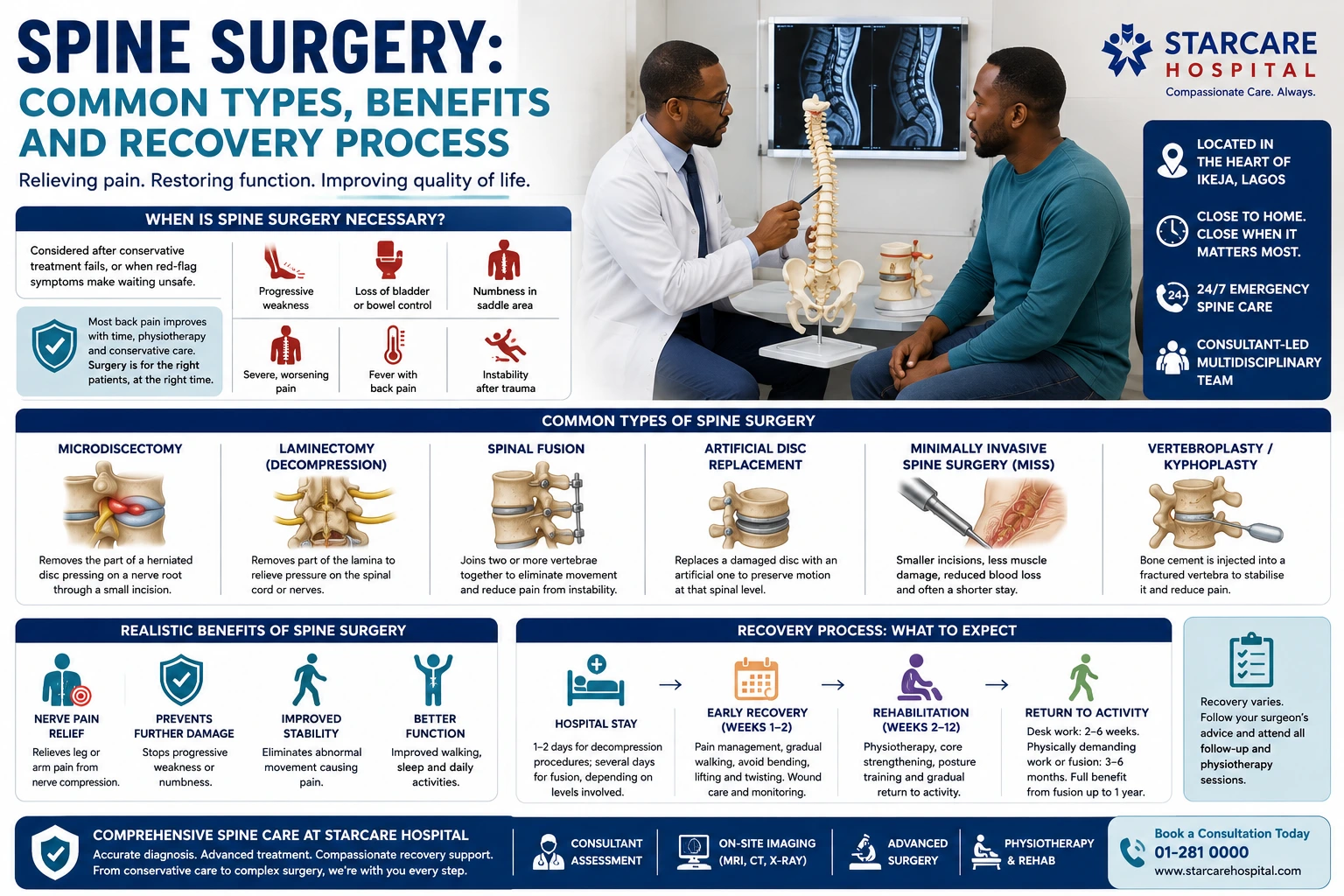
Surgery is considered only after conservative treatment — physiotherapy, medication, activity modification, sometimes injections — has been tried for a reasonable period without adequate improvement, **or** when specific red-flag symptoms make waiting unsafe.
**Red flags that warrant urgent evaluation:**
- Progressive weakness in a leg or arm
- Loss of bladder or bowel control (a possible sign of cauda equina syndrome, a surgical emergency)
- Numbness in the saddle area
- Severe, worsening pain despite rest and medication
- Signs of spinal infection — fever with back pain
- Instability following trauma
For most other back and neck pain, surgery is a considered decision made jointly between patient and surgeon after conservative options have had a genuine trial — typically six to twelve weeks, unless red flags are present.
## Common Spine Surgery Types
### Microdiscectomy
The most frequently performed procedure for a herniated disc pressing on a nerve root. The surgeon removes the portion of disc material causing compression, relieving pressure on the nerve. It's typically done through a small incision using magnification, and many patients notice significant leg pain relief within days.
### Laminectomy (Decompression Surgery)
Removes part of the vertebral bone (the lamina) to relieve pressure on the spinal cord or nerves, most often used for spinal stenosis — a narrowing of the spinal canal common in older adults. Patients often present with pain that worsens on walking and eases when leaning forward, a pattern called neurogenic claudication.
### Spinal Fusion
Joins two or more vertebrae together using bone grafts, screws and rods, eliminating movement between them. Used for instability, spondylolisthesis (a vertebra slipping forward), severe degenerative disc disease, or after removing a significant amount of bone during decompression. Fusion is a bigger undertaking than decompression alone and is reserved for cases where instability is a real concern.
### Artificial Disc Replacement
An alternative to fusion in selected cases, replacing a damaged disc with an artificial one that preserves some natural movement at that spinal level. Not suitable for every patient — significant arthritis or instability usually rules it out.
### Minimally Invasive Spine Surgery (MISS)
Rather than a distinct procedure, this is an approach — using smaller incisions, specialised retractors and, often, microscopic or endoscopic visualisation — applied to many of the procedures above. Benefits typically include less muscle damage, reduced blood loss, and often a shorter hospital stay, though not every case is suitable for a minimally invasive approach.
### Vertebroplasty and Kyphoplasty
Used for painful vertebral compression fractures, often from osteoporosis. Bone cement is injected into the fractured vertebra to stabilise it and reduce pain, typically as a same-day or overnight procedure.
## Realistic Benefits of Spine Surgery
Set against genuine clinical need, spine surgery can offer:
- **Nerve pain relief** — decompression procedures are generally very effective for leg or arm pain caused by nerve compression
- **Prevention of further neurological damage** — critical when weakness or numbness is progressive
- **Improved stability** — fusion can eliminate the abnormal movement causing pain and further wear
- **Better function** — reduced pain generally means improved walking distance, sleep and daily activity
One honest caveat: surgery for *back pain alone*, without clear nerve compression or instability on imaging, has a far less predictable success rate than surgery for leg pain from nerve compression. This is a conversation every patient deserves before consenting to a procedure — a reliable surgeon will have it with you directly.
## What Determines the Right Type of Spine Surgery
Every case is individual. Surgeons weigh:
- Precise diagnosis, confirmed by MRI, CT or X-ray correlated with the clinical exam
- Which spinal level and structure is involved
- Whether instability is present
- The patient's age, bone quality and overall fitness for surgery
- Prior treatment response
- Patient goals and occupational demands
This is why a thorough pre-operative work-up — imaging plus a genuine hands-on examination, not imaging alone — matters as much as the surgery itself.
Recovery Process: What to Expect
Hospital stay: Microdiscectomy and minimally invasive decompression often allow discharge within a day or two. Fusion surgery typically requires a longer stay, often several days, depending on the number of levels involved.
**Early recovery (weeks 1–2).** Pain management, gradually increasing walking, and avoiding bending, lifting and twisting. Wound care and monitoring for infection.
**Rehabilitation (weeks 2–12).** Structured physiotherapy begins once the surgeon confirms it's safe, focusing on core strengthening, posture and gradual return to normal movement. This phase is not optional extra effort — it substantially determines the final outcome.
**Return to activity.** Desk-based work is often possible within two to six weeks depending on the procedure. Physically demanding jobs and fusion surgery generally require longer, sometimes three to six months.
**Long-term outcome.** Full benefit from fusion surgery can take up to a year as bone graft consolidates. Decompression-only procedures tend to show improvement faster.
Recovery timelines vary by procedure, patient health and adherence to rehabilitation — your surgeon should give you a timeline specific to your case, not a generic one.
## Spine Care at Starcare Hospital
Spine care at Starcare Hospital follows the same principle that governs sound orthopedic and neurosurgical practice everywhere: exhaust appropriate conservative treatment first, operate only when there is a clear clinical indication, and be transparent with patients about realistic outcomes — including whenwatchful waiting is the better recommendation. Consultant-led assessment, on-site imaging, and structured post-operative physiotherapy support patients through the full recovery process, not just the operation itself.
If back or neck pain has come with red-flag symptoms, or hasn't responded to weeks of conservative treatment, it's worth a proper specialist evaluation rather than continuing to manage it alone.
## Frequently Asked Questions
**How do I know if I need spine surgery?**
Surgery is usually considered after conservative treatment has failed over several weeks, or immediately if you have red-flag symptoms like progressive weakness, loss of bladder or bowel control, or fever with back pain.
**Is spine surgery always a major procedure?**
No. Many modern procedures, including microdiscectomy and minimally invasive decompression, are done through small incisions with short hospital stays. Fusion surgery is more extensive.
**How long is recovery after spine surgery?**
It depends on the procedure — often one to two weeks for early recovery from decompression surgery, with full rehabilitation taking up to three months, and up to a year for fusion to fully consolidate.
**Does spine surgery guarantee complete pain relief?**
No procedure guarantees complete relief. Outcomes are generally strongest for nerve-related pain from compression and less predictable for back pain without a clear structural cause.
**Where can I get spine care in Lagos?**
Starcare Hospital offers consultant-led spine assessment, on-site imaging and post-operative rehabilitation support for patients requiring spine care in Lagos.
News & Updates...

Children experience a range of common health concerns, from fevers and respiratory infections to stomach problems, allergies, and developmental challenges. Knowing which symptoms are normal and which require prompt medical attention is an important part of keeping your child healthy. This blog explores common childhood illnesses, warning signs that may require emergency care, and the importance of age-appropriate examinations, weight-based medication dosing, immunisations, growth monitoring, and developmental assessments. Discover how Starcare Hospital's pediatric services focus on family-centred care, careful diagnosis, preventive health, and timely treatment to support children through every stage of development.
Finding the best hospital in Ikeja for your family isn't just about choosing the closest facility. It's about finding a healthcare provider that offers qualified doctors, reliable emergency services, transparent billing, and care tailored to your family's needs. This blog explores the key factors to consider when choosing a hospital in Ikeja, including HEFAMAA registration, MDCN-registered consultants, specialist departments, on-site diagnostics, HMO coverage, and genuine 24-hour emergency capabilities. Discover how Starcare Hospital focuses on consultant-led care, patient safety, transparent pricing, and consistent healthcare services to support families in Ikeja and across Lagos.