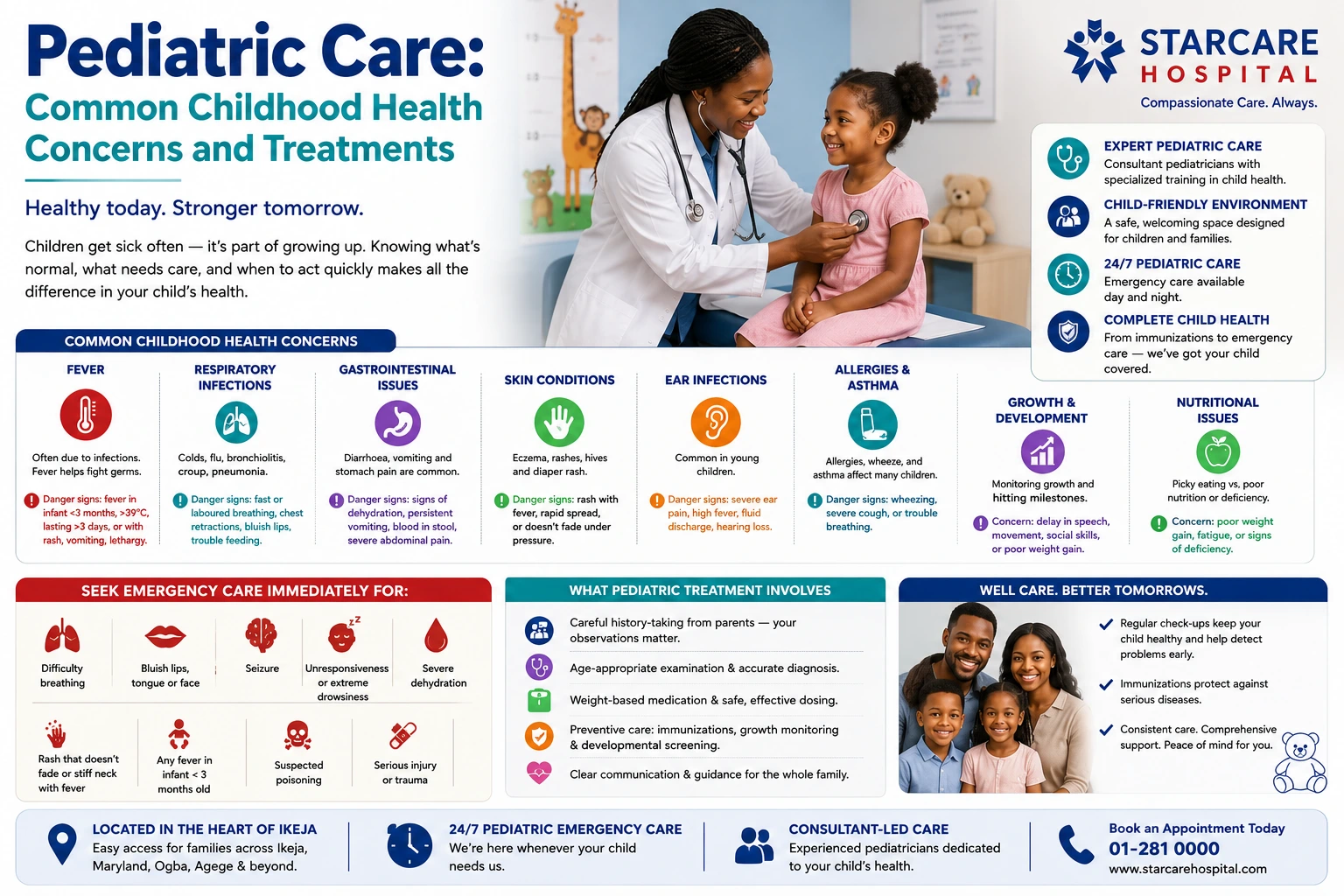
Pediatric Care: Common Childhood Health Concerns and Treatments
Children experience a range of common health concerns, from fevers and respiratory infections to stomach problems, allergies, and developmental challenges. Knowing which symptoms are normal and which require prompt medical attention is an important part of keeping your child healthy. This blog explores common childhood illnesses, warning signs that may require emergency care, and the importance of age-appropriate examinations, weight-based medication dosing, immunisations, growth monitoring, and developmental assessments. Discover how Starcare Hospital's pediatric services focus on family-centred care, careful diagnosis, preventive health, and timely treatment to support children through every stage of development.
Every parent learns the same lesson eventually: children get sick often, and most of it is ordinary. A toddler in daycare will catch a cold every few weeks. A school-age child will pick up a stomach bug that sweeps through the classroom. This is normal immune development, not a sign that something is wrong. The harder skill is knowing which symptoms are routine and which ones need a pediatric specialist's attention quickly.
This guide covers the childhood health concerns seen most often, what treatment typically involves, and the warning signs that shouldn't wait for a routine appointment.
Why Pediatric Care Is Different From Adult Medicine
Children aren't small adults. Their bodies respond differently to illness, medications are dosed by weight and age rather than a fixed adult dose, and normal ranges for heart rate, breathing rate and temperature shift as a child grows. A fever that's manageable in a seven-year-old can be far more concerning in a six-week-old. This is why pediatric treatment requires training specific to children, not general medical knowledge applied at a smaller scale.
Good pediatric care also treats the family, not just the child. Parents are the ones observing behaviour, feeding and sleep patterns around the clock, and a good pediatrician listens to that observation as seriously as the physical exam.
Common Childhood Health Concerns
Fever
The most frequent reason parents seek pediatric care. Fever itself is not dangerous it's the body's normal response to infection but its context matters enormously.
Seek same-day assessment if: the child is under three months old with any fever, the fever exceeds 39°C (102.2°F), it persists beyond three days, or it comes with lethargy, difficulty breathing, a rash, repeated vomiting, or refusal to feed.
Respiratory Infections
Colds, bronchiolitis, croup and pneumonia account for a large share of pediatric visits, especially during the rainy season. Most colds resolve on their own within a week to ten days with rest and fluids.
Warning signs needing prompt evaluation: fast or laboured breathing, visible chest retractions, bluish lips, or a child too breathless to feed or speak in full sentences.
Gastrointestinal Issues
Diarrhoea, vomiting and abdominal pain are common and usually self-limiting. The real risk in young children is dehydration, which can develop quickly.
Signs of dehydration: fewer wet nappies or reduced urination, dry lips and mouth, sunken eyes, unusual sleepiness, absence of tears when crying. Oral rehydration solution, not plain water alone, is the standard first response.
Skin Conditions
Eczema, diaper rash, heat rash and viral rashes are extremely common in childhood. Most are manageable with simple measures — moisturising, barrier creams, avoiding irritants — but a rash accompanied by fever, or one that spreads rapidly and doesn't fade under pressure, needs urgent review, as it can occasionally signal a serious infection.
Ear Infections
Middle ear infections are especially common in younger children, partly due to the shorter, more horizontal shape of a child's ear canal. Signs include ear tugging, irritability, disrupted sleep and sometimes fever. Many resolve without antibiotics, but persistent or recurrent infections warrant specialist assessment.
Allergies and Asthma
Allergic reactions range from mild skin reactions to severe, rapid-onset anaphylaxis. Asthma often first appears in childhood, presenting as recurrent cough, wheeze or breathlessness, particularly at night or during exercise. Early, accurate diagnosis and a clear action plan make a significant difference to a child's quality of life.
Growth and Developmental Concerns
Not every childhood health concern is acute. Parents sometimes notice a child isn't meeting expected milestones — walking, talking, social interaction — or that growth has slowed on the growth chart. These deserve a structured developmental assessment rather than a "wait and see" approach, since early intervention services are far more effective the earlier they begin.
Nutritional Issues
Picky eating is common and usually not a medical problem. Genuine concerns include poor weight gain, signs of nutrient deficiency, or feeding difficulties in infancy. A pediatric specialist can distinguish normal fussiness from something needing dietary or medical intervention.
When to Seek Emergency Care Immediately
Some symptoms bypass the "wait and watch" approach entirely:
- Difficulty breathing or persistent rapid breathing
- Bluish lips, tongue or face
- Seizure, especially a first-time seizure
- Unresponsiveness or extreme difficulty waking
- Severe dehydration
- A stiff neck with fever, or a rash that doesn't fade under pressure
- Any fever in an infant under three months old
- Suspected poisoning or serious injury
Parental instinct matters here. If something feels seriously wrong with your child, that concern is reason enough to seek immediate assessment — pediatric emergency staff would always rather see a worried family early than late.
What Pediatric Treatment Typically Involves
Careful history-taking. A good pediatric consultation draws heavily on what parents or caregivers have observed — feeding, sleep, behaviour, the pattern of symptoms over time.
Age-appropriate examination. Pediatric specialists are trained to examine children calmly and thoroughly, adapting technique to age, from newborns to teenagers.
Weight-based, careful dosing. Medication doses are calculated by weight, with close attention to age-specific safety — a detail that matters more in pediatric care than almost anywhere else in medicine.
Preventive care. Routine immunisation, growth monitoring and developmental screening catch problems before they become symptomatic, and remain among the most effective interventions in all of medicine.
Family-centred communication. Explaining a diagnosis and treatment plan in terms parents can actually act on, and checking they understand warning signs before they leave.
Pediatric Services at Starcare Hospital
Starcare Hospital's pediatric services are built around this same principle: careful, unhurried assessment, weight-appropriate treatment, and honest guidance to parents about what needs attention now versus what can be safely monitored at home. Consultant pediatricians work alongside on-site laboratory and imaging support, so that when a child needs further investigation, it happens without unnecessary delay or a trip across the city.
Routine immunisation schedules, growth monitoring and general pediatric treatment are handled alongside acute care, so families have one consistent point of contact for a child's health rather than starting over with a new provider each time.
If your child has a symptom that concerns you whether it fits neatly into "wait and see" or not a pediatric specialist's assessment is rarely a wasted visit.
Frequently Asked Questions
When should I take my child to a pediatric specialist instead of waiting it out?
Any fever in an infant under three months, breathing difficulty, signs of dehydration, a rash with fever, lethargy, or symptoms lasting longer than expected all warrant prompt assessment rather than waiting.
Is fever in children always something to worry about?
No fever is a normal immune response and most fevers resolve on their own. Age, height of the fever, duration and accompanying symptoms determine whether it needs urgent evaluation.
How often should my child see a pediatrician for routine care?
Regular well-child visits for growth monitoring, developmental checks and immunisations are recommended throughout infancy and childhood, with frequency decreasing as children get older. Your pediatrician can confirm the right schedule for your child's age.
Does Starcare Hospital offer pediatric emergency care?
Yes Starcare Hospital provides pediatric care around the clock, with consultant pediatricians and on-site diagnostics available for urgent childhood health concerns.
What should I bring to my child's first pediatric appointment?
Any previous medical or immunisation records, a list of current symptoms and their timeline, your child's growth history if available, and a note of any medications or allergies.
News & Updates...

Finding the best hospital in Ikeja for your family isn't just about choosing the closest facility. It's about finding a healthcare provider that offers qualified doctors, reliable emergency services, transparent billing, and care tailored to your family's needs. This blog explores the key factors to consider when choosing a hospital in Ikeja, including HEFAMAA registration, MDCN-registered consultants, specialist departments, on-site diagnostics, HMO coverage, and genuine 24-hour emergency capabilities. Discover how Starcare Hospital focuses on consultant-led care, patient safety, transparent pricing, and consistent healthcare services to support families in Ikeja and across Lagos.
Spine surgery can be an effective treatment for patients experiencing nerve compression, spinal instability, or structural spinal problems that have not improved with conservative care. However, surgery is not always necessary for back or neck pain. This blog explores common spine procedures, including microdiscectomy, laminectomy, spinal fusion, artificial disc replacement, and minimally invasive spine surgery. It explains when surgery may be recommended, the potential benefits, and what patients can expect during recovery and rehabilitation. Discover how proper diagnosis, specialist consultation, realistic expectations, and physiotherapy play an important role in successful spine care. Starcare Hospital offers consultant-led assessment, diagnostic support, and rehabilitation-focused care for patients seeking spine treatment in Lagos.